During my Lacrosse Goalie Summits I bring together 12 of the best goalie coaches in the sport to teach the position to the young goalies.
I’ll never forget one Goalie Summit where a coach was teaching save technique and was preaching the value of stepping at a 45-degree angle to make saves.
In the very next session, a mere 30 minutes later, a different coach said, “Don’t step at the 45. Step laterally.”
Every goalie who sat through both immediately had the same question: wait, which is it?
If you’ve ever had a high school coach and a private goalie coach, you know the feeling. You walk away from one practice doing things one way, then show up to another and get told the opposite.
So how do you handle it?
Here’s my playbook.
First, Get This Out of the Way
Ask three goalie coaches how to make saves and you’ll get four different answers.
That’s just the nature of the position.
There is no single right way to play goalie. Yes, there are fundamentals and non-negotiables — but two goalies with different builds and skill sets shouldn’t play exactly the same.
Some goalies have fast hands or fast feet. Some goalies are big bodies that occupy a lot of the goal.
Look at Logan McNaney next to Liam Entenmann.
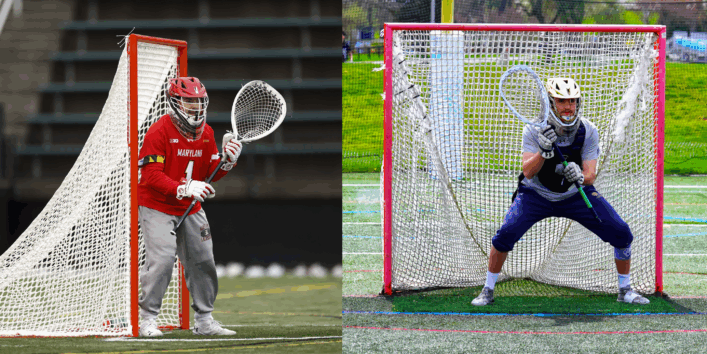
These are two elite goalies. Both have the basics down. But you cannot tell me you’d coach them to play 100% the same way.
Any coach who insists there’s only one right way to play the position is wrong.
With that out of the way, here’s the playbook for the next time you get conflicting advice.
Step 1: Ask Why
The first step is seeking clarity in why the coach is teaching a specific technique.
Coaches should be able to explain the reasoning and logic behind their lessons.
If a coach can’t tell you why they want you to do something — or the answer is “that’s how I was taught” — that’s a red flag.
Be curious, not confrontational.
Yes this – “Coach, can you help me understand why you want me to step out higher?”
Not this – “But Coach Damon says I should play a flatter arc.”
Sometimes once you understand the why, you realize it’s not actually a conflict. Two coaches taking different routes to the same destination.
Step 2: Say “Yes Coach” and Try It
This is the most important step in the playbook.
When a coach gives you feedback, the answer is “Yes Coach.” Then you go try it.
The absolute last thing you should do is tell a coach you won’t do something because another coach said otherwise. That’s a fast track to the bench and a reputation as “uncoachable”.
Going back to Logan vs. Liam — if you’re a shorter goalie and your coach tells you to widen your stance more like Liam, give it a shot. Try it for a few practices and see how it feels.
Who knows? You might feel more athletic and explosive. You might stumble onto something that works better for you.
You can always record yourself with an iPhone and review it after the fact (even with the coaches) to really understand if you’re playing better or worse. Record some raw data to analyze, that way it’s not just opinions.
If this new technique doesn’t work? Great, now you have proof. That will increase your confidence because you’ll never have to wonder “hmm, would a wider stance have been better?”
You already tried it and can say with certainty it’s not for me.
Step 3: Have the 1v1 Conversation
If you’ve genuinely given the technique a fair shot and it’s not working, it’s time for a respectful 1v1 conversation with the coach.
Here’s a script you can steal:
“Coach, I’ve been working on widening my stance like you suggested. I gave it a real shot in practice the last few weeks, but I feel a lot more athletic and make more saves with a slightly narrower base. Would it be okay if I went back to that setup?”
It’s a respectful and honest approach. And at the end of the day, your coach should want whatever gives you the best chance to make saves.
Most coaches will respect a goalie who tried, paid attention to the results, and came to them like an adult.
I also wouldn’t hesitate to loop in your private coach. A lot of kids treat their school coach and private coach as totally separate worlds.
If your high school coach played attack in college and is changing your goalie game around, we’ve got to involve your goalie coach.
When your school coach tells you something that contradicts what you’ve been working on, the next text to your private coach should be: “Hey, my school coach wants me to step at the 45 — can we talk about it next session?”
Your private coach can also serve as a resource to help you navigate the 1 on 1 conversation I mentioned earlier.
Step 4: At Higher Levels, Results Matter More Than Style
A quick story.
I grew up playing youth CYO basketball starting in 2nd grade. We had a really good team and won the league championship nearly every season.
By the time we reached 7th grade we all went out for our junior high team and we were a well oiled machine that had been running together for 5 years.
The 7th grade basketball coach was new. A math teacher who clearly knew more about equations than fast breaks.
One day he demonstrated a 1v1 defensive technique that was so awkward we could barely keep straight faces.
We tried it for a few practices and clearly knew this is not how you play defense.
Come game time, we played defense the way we’d learned over five years. We won by 20.
He never said a word.
Why? Because we were getting results.
As you move up in competitive levels, coaches care less about how you make saves and more about whether you make saves. If you’re stopping shots and your team is winning, you’ll get less nitpicking about technique.
But that cuts both ways. If you’re struggling, and defying the coaches you’ll face repercussions. expect changes. And if a coach with real goalie expertise is offering you advice, always be humble enough to listen.
One Important Caveat
The playbook above is for conflicts of style — stance width, step angle, arc depth, save mechanics. Reasonable goalie minds disagree on this stuff all the time.
A conflict over a real fundamental is different. Dipping your hands on shots. Or not moving your feet on shots.
Those are real issues that need to be addressed.
Another important caveat is timing. I’m very much against goalies making big overhauls to their game mid-season. That’s an off season task because many times things get worse before they get better.
So if a coach suggests a big overhaul mid-season, try to negotiate the timing and suggest we work on that in the off-season.
The Bottom Line
The best goalie coaches I know never try to revamp a goalie’s technique. They work with what they’re given and refine the edges.
But you’ll run into “my way or the highway” coaches too. When you do, here’s the playbook:
- Ask why — seek clarification, understand the reasoning
- Try it — say “Yes Coach” and give it a real shot
- Have the 1v1 — if it doesn’t work, advocate for yourself respectfully
- Watch the results — at higher levels, saves talk louder than style
Your job isn’t to prove coaches wrong. It’s to keep getting better. Sometimes that means trying something uncomfortable. Sometimes it means going back to what works. Always it means staying curious.
Any goalies out there dealing with conflicting coaching advice right now? Drop it in the comments and let’s talk it through.
Until next time, Coach Damon

















 14 Amazing Lacrosse Goalie DrillsAug. 1, 2024
 Quick Guide To Lacrosse Slang TermsApril 14, 2025
 Lacrosse Goalies Rules To KnowJune 28, 2022
 Lacrosse Goalie Step-by-Step Guide to Getting RecruitedFebruary 6, 2022
 18 Lacrosse Goalie Drills to Improve Your GameApril 24, 2025
 7 Elements of a Great Lacrosse Goalie StanceAug. 1, 2020
 12 Lacrosse Goalie Tips To Take Your Game to the Next LevelSeptember 10, 2024
 STX Eclipse 3 Goalie Head ReviewApril 24, 2025
 Lacrosse Goalie WorkoutAug. 12, 2019
 The Basics of Making a SaveJune 29, 2021