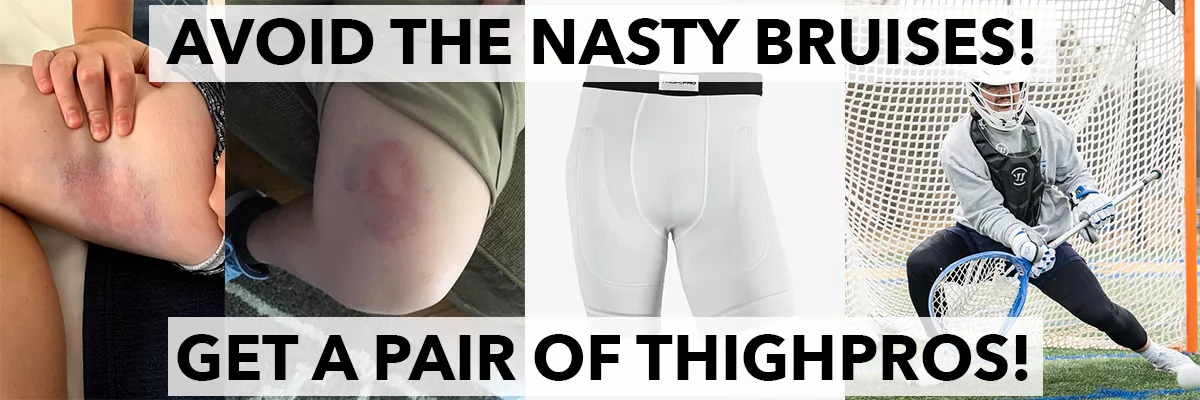
This episode is sponsored by Thigh Pro. Use that special link for 10% off.
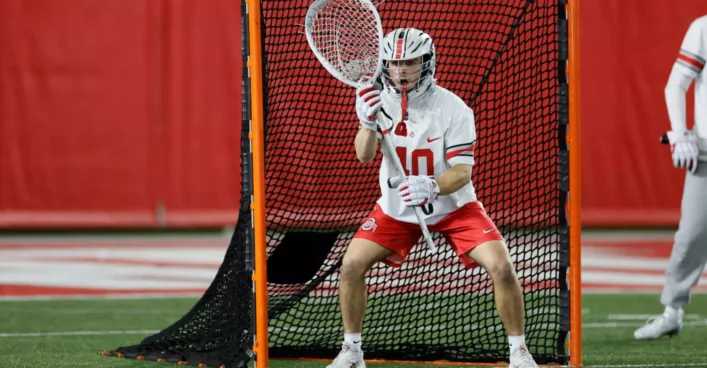
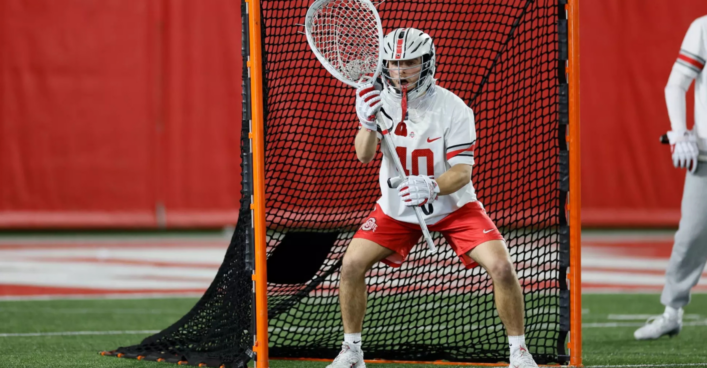
Most goalies who end up starting in the Big Ten have a fairly recognizable origin story. Youth club, a hotbed high school, the summer recruiting circuit, a commitment. Jack Allen’s story detours through a men’s league in the English countryside, a lot of unanswered recruiting emails, and a French word that has become his personal reset button.
Jack was born in Syracuse and started playing at three years old, when a babysitter handed him and his brother a set of mini sticks. He went straight into the cage and never really came out.
“My parents always say, you’re playing mini sticks, and the next thing you know you’re just standing in cage. I don’t know what it was about it, but I was always drawn to it.”
That pull wasn’t specific to lacrosse. Jack grew up watching soccer, too, and gravitated to the keeper in that sport as well. “Any sport, I was like, oh, the goalie’s sick. I like that.”
Learning the Position in Ohio
The family moved to Ohio when Jack was about four, and that’s where the position work really started. He developed through the Resolute club program and worked with local goalie coach Stefan Schroeder, but he credits a big chunk of his early growth to something a lot less structured: just watching lacrosse.
“Resolute was a big proponent of, just watch lacrosse. Lacrosse is fun. There’s so much of it at so many different levels.”
For young goalies asking how to build their film IQ, Jack’s advice is to stop trying to take notes and start absorbing.
“Every goalie basically has different unique styles and how they play different things. Look at how a goalie stands, how they play their angles, where their hands are placed. Try and find a goalie that you can model your game off.”
Add clearing game to that list. Where does he look first after the save? Second? Third? How does he exit the crease and create a two-on-one? There’s a full curriculum in the twelve seconds after a stop that most young goalies never watch.
Playing Men’s League at 10 Years Old
At 10, Jack’s family moved to England, and the lacrosse landscape changed completely. Men’s lacrosse there is a niche sport, concentrated up north around Manchester, and it carries a working-class, blue-collar identity — guys coming off a shift to go play.
Jack was living in Cambridge, roughly three hours from the hotbed. His options were limited. So he played with grown men.
“There’s videos of me when I was 10 playing with guys in college,” he said. He couldn’t play in sanctioned games until 16 without league approval, but he was in the cage taking shots from adults — university players and servicemen from nearby U.S. Air Force bases — long before that.
For a kid, that could have been intimidating. It wasn’t, and Jack’s explanation is refreshingly simple: he wanted to play lacrosse, and this was how he could play lacrosse.
“Those guys were so good at bringing me in and making me feel like part of the team. I didn’t really think, like, they were 15 years older than me.”
He also credits the crease. “As a goalie, you’ve got the goal circle around me. A little bit of protection. I wasn’t getting hit by them.”
Just by 85 mile-an-hour rubber. Which, for the record, he liked.
“They tried to put me in leg pads and I wasn’t big on it. I kind of like getting hit by the ball, if I’m honest. Especially when you’re younger — oh, I got a bruise. This is pretty sweet.”
The Mental Game: Resets, Slumps, and “Boof”
The through-line of the whole conversation is fun — not as a platitude, but as an active technique for staying good.
“It’s a unique spot that we’re put in as goalies. A lot of times people can get bogged down in the negatives. But on the complete flip side, you can make saves and win games.”
When Jack gets in his own head, he does two things. First, he goes and gets reps — targeted ones.
“Say it’s a step-down that I’m struggling with. I get shooters to shoot that step-down. It doesn’t need to be a crazy long period of time, but if I can get ten, fifteen minutes and start feeling good about it, I’m not stressing about it the next couple days.”
Second, he goes home and watches old highlight reels — MLL-era Drew Adams, John Galloway, Brett Queener.
“Look at how fun it is. You’re like, wow, I’m making this into something bigger than it is. Look at these guys just balling out.”
In-game, he leans on a reset routine that started with an England youth national team exercise called “blue light” — pick a point far in the distance, say a code word, do a small physical action, take a breath, and flush it. It’s evolved into a four-second box breath now. And a code word he picked up on a trip to France with his girlfriend.
“It’s called boof. It doesn’t really mean anything, and I just got a kick out of it. Bad shot goes in — boof. You get the next one. It’s a word that makes me giggle, makes me laugh, and recenters myself.”
He also has access to sports psychology at Ohio State, and he’s used it.
“It allows you to have a space to talk about lacrosse and your performance without the pressure. They don’t care if you’re saving the ball at 60 percent. They just want you to be a successful person.”
Getting Recruited From 3,500 Miles Away
International recruiting is hard for a reason: nobody sees you. Jack’s route was the one most international players end up on — go play for your country, at the biggest event you can find.
He played for Team England at the U21 World Championship (delayed by COVID) and was a Euro Lax champion with Team Great Britain. That’s where Ohio State head coach Nick Myers, who was coaching against him, first saw him play.
The rest was volume.
“I sent so many emails in recruiting. So many emails, updates, all this stuff. Usually there’s no response. But it was pretty sweet when I got a response.”
Jack’s advice on picking a school is worth reading twice, especially for kids chasing a roster spot at any cost:
“You’ve got to be able to say, all right, if I didn’t play lacrosse here, I’d still be having a good time with my life. You’re not just going somewhere on the hopes of playing lacrosse, because sometimes lacrosse doesn’t work out.”
“Rubber Band, Not a Slinky”
At 5’9″, Jack doesn’t fill up the cage, and that’s shaped how he’s had to develop in college. He worked with former Buckeye goalie coach Andrew Vossler for his first two seasons and now works with Coach Tuma, whose favorite analogy has stuck.
“He wants me to be like a rubber band, not a slinky. A slinky is all over the place. The rubber band is controlled. It’s explosion, but then it comes back.”
The tempting thing for an athletic small goalie is to do more — bigger steps, earlier flops, more explosion out of the cage. Jack’s growth has been in doing less, later.
“If I make a false step, that’s when I find myself getting scored on the most. Whereas if I’m actually just set — in some ways waiting longer for the shot, feeling like I’m being slower to pick it up — and then putting all my force into going straight to the ball, that tends to lead to more success.”
His toughest college adjustment? Up-the-hash shots. Which, notably, is the same answer Brett Dobson gave about coming out of Canada.
“Growing up, I don’t really remember seeing guys shoot the ball at the hash. I’d watch lacrosse and it would be routine — goalie makes the save, nobody thinks anything of it. Then you get in cage and you’re like, they shouldn’t have anywhere to go. But it’s weird.”
Advice for smaller goalies
Lean on your athleticism — most short goalies who play at a high level are quick, and quickness is the trade
Understand exactly what space you’re giving up, rather than pretending you cover more net than you do
Sit back a touch and read the shot rather than aggressively taking away angle
Obsess over the first move — no hitch, no false step, straight to the ball
Backing Up Big Tasty
Jack shares a goalie room with Caleb “Big Tasty” Fyock, one of the more distinctive players in college lacrosse, and the thing he’s tried hardest to steal isn’t technical.
“How calm he is, and how he plays with such poise at all times. Even if he gets scored on, the next shot he doesn’t seem any different than the previous shot.”
The other lesson is about using what you have. Fyock plays an up-the-hash shot completely differently than Jack does, and Jack’s takeaway is to be honest about which version of the position you’re actually playing.
“He uses his build and his frame to make saves better than anyone I’ve ever seen.”
That preparation paid off against Rutgers, when Jack came off the bench mid-game — something he’d never done before.
“Probably the most nervous I’ve ever felt. I’ve never really come off the bench as a goalie and had to go right away without settling into the game. But once you get out there and make that first save, you settle down. It’s just lacrosse.”
He played a career-high 39:05, made 10 saves, and Ohio State won 6-5. He was named Big Ten co-Player of the Week for it.
His note for every backup: warm up like you’re playing, and don’t just take shots.
“Throw the ball. A lot of times goalies just take shots. You’re going to end up having to outlet the ball and clear it too. It’s not a one-dimensional game of saving the ball. Sometimes we get caught up on that.”
STX Lacrosse — Ohio State’s equipment partner and Jack’s gear
Jack Allen Gear Setup
Jack is a self-described gear guy, and his setup is dialed in rather than exotic. Ohio State is an STX school.
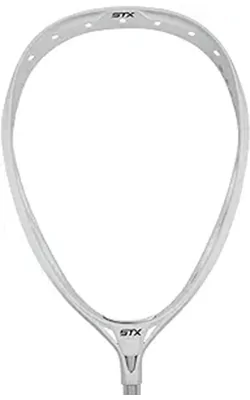
Head: STX Eclipse 3 — he was an Eclipse 2 loyalist growing up and needed time to adjust to the Eclipse 3’s forward lip
Mesh: STX Memory Mesh, 12-diamond semi-soft — he likes it for weather consistency, since traditional and hockey-lace style pockets can absorb moisture and change how the stick throws
Pocket: Mid-to-low, not overly deep, strung by Ross Laverne at Lacrosse Unlimited. The key adjustment was an inverted top string — the back portion of the knot sits on the front of the scoop instead of the back, which helps the ball release cleanly instead of hooking into the turf
Release preference: He wants to feel the ball rip off the plastic. “Otherwise I’m throwing it and I don’t know where it is.”
Shaft: Attack-length. He tried a goalie shaft as a kid, but his coach said he was too small to move with it, and he never went back. Usually an STX Sci-Ti X, sometimes a fiber shaft for the lighter weight
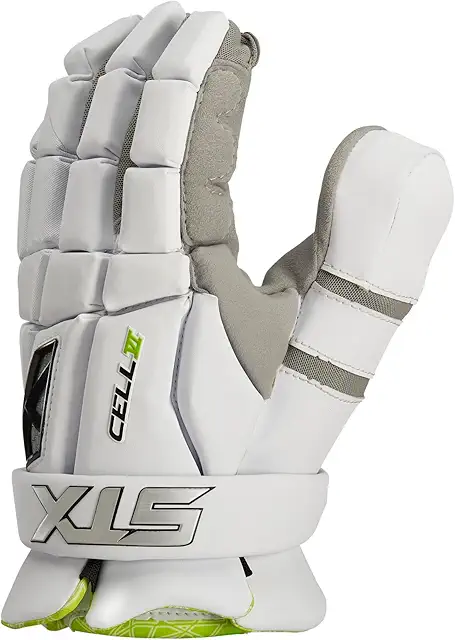
Gloves: STX RZR 2 — he prefers them over the Cell 6 for the foam, the flexibility, and the exoskeleton shell that extends over the top of the hand where goalies commonly get stung
Chest protector: STX Shield 600. He’s handled the new Eclipse 600 at a team demo but hasn’t fully switched. “Once a chest pad breaks in and gets less stiff, you’re comfortable. I’m not too worried about it as long as it’s protective and I can move in it.”
Final Advice
Jack has two years left at Ohio State, with an eye on more Team England play afterward and, in the back of his mind, LA 2028. His parting message for young goalies came back around to where the conversation started.
“Your body at some point isn’t going to be in a great spot where you can play lacrosse. Understand that while you’re playing lacrosse, it’s a privilege. Have fun with it. It’s the medicine game after all. Lacrosse will give you a lot — try and give back to it as much as you can too.”
Unlock your full potential inside the premier training program for lacrosse goalies. Get exclusive access to technique tutorials, drills, mental game strategies, lacrosse IQ development, and direct coaching from Coach Damon. Join 400+ goalies who are leveling up their skills and confidence.
Being a goalie parent is harder than playing the position. That’s why I created the Lacrosse Goalie Super Mom/Dad course - designed for parents with zero lacrosse experience who still want to support their goalie. You’ll learn how to train them (yes, really), but more importantly, how to guide them through the emotional highs and lows of the game.
Promote your brand, product, or service by sponsoring the Lax Goalie Rat newsletter. It's the easiest way to get noticed by a passionate and highly targeted community of lacrosse goalies and coaches.
Lacrosse is my passion! The game has given me so much and this blog is my way of giving back to the lax community. Specifically the most bad a$$ part of that community - the goalies! After learning to play goalie from scratch, I wanted to create a site where I could share what I learned with others so they too can become champions in the crease and in life. Learn more about Coach Damon.
Elevate Your Lacrosse Goalie’s Game with Expert Coaching!
Join the Lax Goalie Rat Academy for top-tier virtual goalie training! Boost your young goalie's confidence, skills, and success - so you can be the proud goalie Mom or Dad on the sideline 🔥



















 14 Amazing Lacrosse Goalie DrillsAug. 1, 2024
 Quick Guide To Lacrosse Slang TermsApril 14, 2025
 Lacrosse Goalies Rules To KnowJune 28, 2022
 Lacrosse Goalie Step-by-Step Guide to Getting RecruitedFebruary 6, 2022
 18 Lacrosse Goalie Drills to Improve Your GameApril 24, 2025
 7 Elements of a Great Lacrosse Goalie StanceAug. 1, 2020
 12 Lacrosse Goalie Tips To Take Your Game to the Next LevelSeptember 10, 2024
 STX Eclipse 3 Goalie Head ReviewApril 24, 2025
 Lacrosse Goalie WorkoutAug. 12, 2019
 The Basics of Making a SaveJune 29, 2021